
North America
& Caribbean |
South America
|
Africa
|
Asia
|
Europe
|
Australia &
Oceania |
Country Rankings
|
Beyond
Earth |
|
mail
ContactUs
|
|
info
AboutUs
|
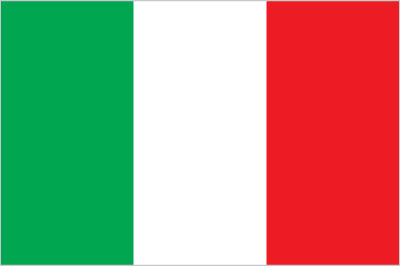
Flag
National anthem
Coat of arms
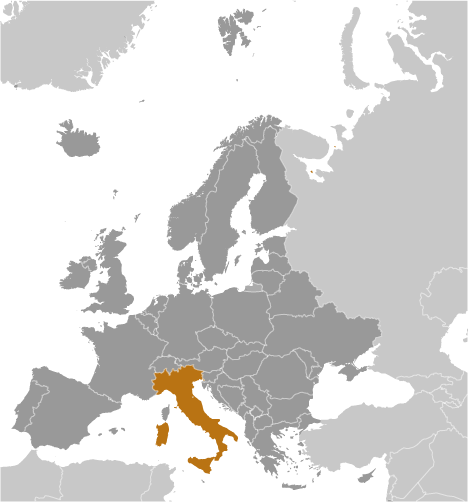
Country location map
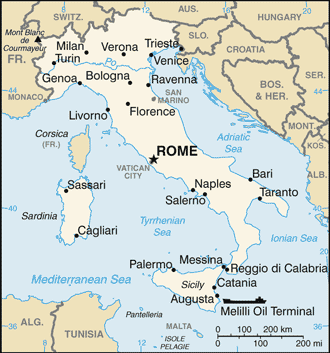
Country static map
Country dynamic (scrollable) map
Current weather & time
-
infoGeneral informationkeyboard_arrow_up
- Country common name: Italy
- Country official name: Italian Republic (Repubblica Italiana)
- Continent: Europe
- 3-Letter abbreviation: ITA
- 2-Letter abbreviation: IT
- Capital: Rome
- Major cities: 4.257 million ROME (capital), 3.140 million Milan, 2.187 million Naples, 1.792 million Turin, 892,000 Bergamo, 851,000 Palermo
- Currency: Euro (click for current conversion rates)
- Languages: Italian (official), German (parts of Trentino-Alto Adige region are predominantly German speaking), French (small French-speaking minority in Valle d'Aosta region), Slovene (Slovene-speaking minority in the Trieste-Gorizia area)
- Motto: "Italy is a Democratic Republic, Founded on Labor"
- National holiday(s): Republic Day, 2 June (1946)
flagGovernmentkeyboard_arrow_up- Chief of state: President Sergio MATTARELLA (since 3 February 2015)
- Head of government: Prime Minister Mario DRAGHI (since 13 February 2021); the prime minister's official title is President of the Council of Ministers; note - Prime Minister Giuseppe CONTE resigned on 26 January 2021
- Government type: parliamentary republic
insert_photoCountry notes & photographskeyboard_arrow_up{"ops":[{"attributes":{"bold":true},"insert":"Italy"},{"insert":" (Italian: "},{"attributes":{"italic":true},"insert":"Italia"},{"insert":" [i·ta·lee·uh] ("},{"attributes":{"alt":"About this sound","height":"11","width":"11","link":"https://upload.wikimedia.org/wikipedia/commons/1/1d/It-Italia.ogg"},"insert":{"image":"https://upload.wikimedia.org/wikipedia/commons/thumb/8/8a/Loudspeaker.svg/11px-Loudspeaker.svg.png"}},{"insert":"listen), officially the "},{"attributes":{"bold":true},"insert":"Italian Republic"},{"insert":" (Italian: "},{"attributes":{"italic":true},"insert":"Repubblica Italiana"},{"insert":" [repubblika itaˆljana]), is a country consisting of a peninsula delimited by the Alps and surrounded by several islands. Italy is located in "},{"attributes":{"bold":true},"insert":"south-central Europe"},{"insert":", but is considered part of Western Europe. A unitary parliamentary republic with "},{"attributes":{"bold":true},"insert":"Rome "},{"insert":"as its capital, the country covers a total area of 301,340 km"},{"attributes":{"script":"super"},"insert":"2"},{"insert":" (116,350 sq mi) and shares land borders with France, Switzerland, Austria, Slovenia, and the enclaved microstates of Vatican City and San Marino. Italy has a territorial enclave in Switzerland (Campione) and a maritime exclave in Tunisian waters (Lampedusa). With around 60 million inhabitants, Italy is the third-most populous member state of the "},{"attributes":{"italic":true},"insert":"European Union"},{"insert":".\n\nDue to its central geographic location in Southern Europe and the Mediterranean, Italy has historically been home to myriad peoples and cultures. In addition to the various ancient peoples dispersed throughout what is now modern-day Italy, the most predominant being the Indo-European Italic peoples who gave the peninsula its name, beginning from the classical era, Phoenicians and Carthaginians founded colonies mostly in insular Italy, Greeks established settlements in the so-called Magna Graecia of Southern Italy, while Etruscans and Celts inhabited central and northern Italy respectively. An Italic tribe known as the Latins formed the "},{"attributes":{"bold":true},"insert":"Roman Kingdom"},{"insert":" in the 8th century BC, which eventually became a republic with a government of the Senate and the People. The "},{"attributes":{"bold":true},"insert":"Roman Republic"},{"insert":" initially conquered and assimilated its neighbours on the Italian peninsula, eventually expanding and conquering parts of Europe, North Africa and Asia. By the first century BC, the Roman Empire emerged as the dominant power in the Mediterranean Basin and became a leading cultural, political and religious center, inaugurating the "},{"attributes":{"italic":true},"insert":"Pax Romana"},{"insert":", a period of more than 200 years during which Italy's law, technology, economy, art, and literature developed. Italy remained the homeland of the Romans and the metropole of the empire, whose legacy can also be observed in the global distribution of culture, governments, Christianity and the Latin script.\n\nDuring the Early Middle Ages, Italy endured the fall of the Western Roman Empire and barbarian invasions, but by the 11th century numerous rival city-states and maritime republics, mainly in the northern and central regions of Italy, rose to great prosperity through trade, commerce and banking, laying the groundwork for modern capitalism. These mostly independent statelets served as Europe's main trading hubs with Asia and the Near East, often enjoying a greater degree of democracy than the larger feudal monarchies that were consolidating throughout Europe; however, part of central Italy was under the control of the theocratic Papal States, while Southern Italy remained largely feudal until the 19th century, partially as a result of a succession of Byzantine, Arab, Norman, Angevin, Aragonese and other foreign conquests of the region. The Renaissance began in Italy and spread to the rest of Europe, bringing a renewed interest in humanism, science, exploration and art. Italian culture flourished, producing famous scholars, artists and polymaths. During the Middle Ages, Italian explorers discovered new routes to the Far East and the New World, helping to usher in the European Age of Discovery. Nevertheless, Italy's commercial and political power significantly waned with the opening of trade routes that bypassed the Mediterranean. Centuries of foreign meddling and conquest and the rivalry and infighting between the Italian city-states, such as the Italian Wars of the 15th and 16th centuries, left Italy politically fragmented, and it was further conquered and divided among multiple foreign European powers over the centuries.\n\nBy the mid-19th century, rising Italian nationalism and calls for independence from foreign control led to a period of revolutionary political upheaval. After centuries of foreign domination and political division, Italy was almost entirely unified in 1861, establishing the "},{"attributes":{"bold":true},"insert":"Kingdom of Italy"},{"insert":" as a great power. From the late 19th century to the early 20th century, Italy rapidly industrialized, mainly in the north, and acquired a colonial empire, while the south remained largely impoverished and excluded from industrialization, fueling a large and influential diaspora. Despite being one of the four main allied powers in World War I, Italy entered a period of economic crisis and social turmoil, leading to the rise of the Italian fascist dictatorship in 1922. Participation in World War II on the Axis side ended in military defeat, economic destruction and the Italian Civil War. Following the liberation of Italy and the rise of the Italian Resistance, the country abolished their monarchy, established a "},{"attributes":{"bold":true},"insert":"democratic Republic,"},{"insert":" enjoyed a prolonged economic boom, and became a highly developed country.\n\nToday, Italy is considered to be one of the world's most culturally and economically advanced countries, with the "},{"attributes":{"bold":true},"insert":"world's eighth-largest economy"},{"insert":" by nominal GDP (third in the "},{"attributes":{"italic":true},"insert":"European Union"},{"insert":"), sixth-largest national wealth and third-largest central bank gold reserve. It ranks very highly in life expectancy, quality of life, healthcare, and education. The country plays a prominent role in regional and global economic, military, cultural and diplomatic affairs; it is both a regional power and a great power, and is ranked the world's eighth most-powerful military. Italy is a founding and leading member of the European Union and a member of numerous international institutions, including the "},{"attributes":{"italic":true},"insert":"United Nations, NATO"},{"insert":", the "},{"attributes":{"italic":true},"insert":"OECD"},{"insert":", the"},{"attributes":{"italic":true},"insert":" Organization for Security and Co-operation in Europe"},{"insert":", the "},{"attributes":{"italic":true},"insert":"World Trade Organization"},{"insert":", the "},{"attributes":{"italic":true},"insert":"Group of Seven"},{"insert":", the "},{"attributes":{"italic":true},"insert":"G20"},{"insert":", the "},{"attributes":{"italic":true},"insert":"Union for the Mediterranean"},{"insert":", the "},{"attributes":{"italic":true},"insert":"Council of Europe, Uniting for Consensus"},{"insert":", the "},{"attributes":{"italic":true},"insert":"Schengen Area"},{"insert":" and many more. The country has long been a global center of art, music, literature, philosophy, science and technology, and fashion, and has greatly influenced and contributed to diverse fields including cinema, cuisine, sports, jurisprudence, banking and business. As a reflection of its cultural wealth, Italy is home to the "},{"attributes":{"bold":true},"insert":"world's largest number of World Heritage Sites (55)"},{"insert":", and is the "},{"attributes":{"bold":true},"insert":"fifth-most visited"},{"insert":" country.\n"}]}terrainGeographic informationkeyboard_arrow_up- Surface area (in km²): 301,340
- Highest point: Mont Blanc (Monte Bianco) de Courmayeur (a secondary peak of Mont Blanc) 4,748 m
- Neighboring countries: Austria 404 km, France 476 km, Holy See (Vatican City) 3.4 km, San Marino 37 km, Slovenia 218 km, Switzerland 698 km
- Neighboring seas and oceans: Mediterranean Sea
- Climate: predominantly Mediterranean; alpine in far north; hot, dry in south
radioRadio stationskeyboard_arrow_upsupervised_user_circlePopulationkeyboard_arrow_up- Population: 62,402,659
- Population density (inhabitants per km²): 207.1
- Average age (in years): 46.5
- Life expectancy at birth (in years): 82.5
- Ethnicity: Italian (includes small clusters of German-, French-, and Slovene-Italians in the north and Albanian-Italians and Greek-Italians in the south)
- Gross domestic product (GDP) per inhabitant (in US dollars): 38,200
- Cultural practices: Chrysanthemums are used at funerals, red flowers indicate secrecy, and yellow flowers indicate jealousy. All make poor gifts.
local_diningPopular food & drinkskeyboard_arrow_up{"ops":[{"attributes":{"bold":true},"insert":"Carbonara"},{"insert":" (Italian:[karbo-na-ra]) is an "},{"attributes":{"bold":true},"insert":"Italian pasta dish"},{"insert":" from "},{"attributes":{"bold":true},"insert":"Rome "},{"insert":"made with "},{"attributes":{"italic":true},"insert":"egg, hard cheese, cured pork"},{"insert":", and "},{"attributes":{"italic":true},"insert":"black pepper"},{"insert":". The dish arrived at its modern form, with its current name, in the middle of the 20th century. The cheese is usually Pecorino Romano, Parmigiano-Reggiano, or a combination of the two. Spaghetti is the most common pasta ("},{"attributes":{"bold":true},"insert":"Spaghetti alla carbonara"},{"insert":") but fettuccine, rigatoni, linguine, or bucatini are also used. Normally guanciale or pancetta are used for the meat component, but lardons of smoked bacon are a common substitute outside Italy. There are many theories for the origin of the name "},{"attributes":{"italic":true},"insert":"carbonara"},{"insert":", which is likely more recent than the dish itself. Since the name is derived from "},{"attributes":{"italic":true},"insert":"carbonaro"},{"insert":" (the Italian word for 'charcoal burner'), some believe the dish was first made as a hearty meal for "},{"attributes":{"bold":true},"insert":"Italian charcoal workers"},{"insert":". In parts of the United States, this etymology gave rise to the term \"coal miner's spaghetti\". It has even been suggested that it was created as a tribute to the "},{"attributes":{"italic":true},"insert":"Carbonari"},{"insert":" ('charcoalmen') secret society prominent in the early, repressed stages of Italian unification in the early 19th century. Many believe that it is an \"urban dish\" from Rome, perhaps popularized by the restaurant "},{"attributes":{"bold":true},"insert":"La Carbonara"},{"insert":" in Rome.\n"}]}
{"ops":[{"attributes":{"bold":true},"insert":"Minestrone "},{"insert":"(/min-e-stro-ni/; Italian: [mine-stro-ne]) is a "},{"attributes":{"bold":true},"insert":"thick soup of Italian origin"},{"insert":" made with "},{"attributes":{"bold":true},"insert":"vegetables"},{"insert":", often with the addition of "},{"attributes":{"bold":true},"insert":"pasta "},{"insert":"or "},{"attributes":{"bold":true},"insert":"rice"},{"insert":", sometimes both. Common ingredients include "},{"attributes":{"italic":true},"insert":"beans"},{"insert":", "},{"attributes":{"italic":true},"insert":"onions"},{"insert":", "},{"attributes":{"italic":true},"insert":"celery"},{"insert":", "},{"attributes":{"italic":true},"insert":"carrots"},{"insert":", "},{"attributes":{"italic":true},"insert":"stock"},{"insert":", "},{"attributes":{"italic":true},"insert":"croutons"},{"insert":", and "},{"attributes":{"italic":true},"insert":"tomatoes"},{"insert":". There is "},{"attributes":{"bold":true},"insert":"no set recipe"},{"insert":" for minestrone, since it can usually be made out of whatever vegetables are at one's disposal. It can be vegetarian, contain meat, or contain an animal bone-based stock (such as chicken stock). Food author Angelo Pellegrini claimed that the base of minestrone is "},{"attributes":{"bold":true},"insert":"bean broth"},{"insert":", and that "},{"attributes":{"bold":true},"insert":"borlotti beans"},{"insert":" (also called Roman beans) \"are the beans to use for genuine minestrone\".\n"}]}
{"ops":[{"attributes":{"bold":true},"insert":"Tiramisu"},{"insert":" (Italian: "},{"attributes":{"italic":true},"insert":"tiramisu"},{"insert":"[tiramisu], from "},{"attributes":{"italic":true},"insert":"tirami su"},{"insert":", \"pick me up\" or \"cheer me up\") is a "},{"attributes":{"bold":true},"insert":"coffee-flavored Italian dessert."},{"insert":" It is made of "},{"attributes":{"italic":true},"insert":"ladyfingers (savoiardi)"},{"insert":" dipped in "},{"attributes":{"italic":true},"insert":"coffee"},{"insert":", layered with a whipped mixture of "},{"attributes":{"italic":true},"insert":"eggs"},{"insert":", "},{"attributes":{"italic":true},"insert":"sugar"},{"insert":", and "},{"attributes":{"italic":true},"insert":"mascarpone "},{"insert":"cheese, flavored with "},{"attributes":{"italic":true},"insert":"cocoa"},{"insert":". The recipe has been adapted into many varieties of cakes and other desserts. Its origins are often disputed among Italian regions "},{"attributes":{"bold":true},"insert":"Veneto "},{"insert":"and "},{"attributes":{"bold":true},"insert":"Friuli Venezia Giulia"},{"insert":". Tiramisu appears to have been invented in the "},{"attributes":{"bold":true},"insert":"1960s "},{"insert":"or "},{"attributes":{"bold":true},"insert":"1970s"},{"insert":", but where and when exactly is unclear. Recipes named \"tiramisu\" are unknown in cookbooks before the 1960s. The word appears in print in Italian in 1980, and in English in 1982. Some accounts of the origin of tiramisu date its invention to the 1960s in the region of Veneto, Italy, at the restaurant \""},{"attributes":{"bold":true},"insert":"Le Beccherie"},{"insert":"\" in "},{"attributes":{"bold":true},"insert":"Treviso"},{"insert":". Treviso is located northwest of Venice on Italy's northern Adriatic coast.\n"}]}
{"ops":[{"attributes":{"bold":true},"insert":"Lambrusco"},{"insert":" (/lam-brusko/; Italian: [lam-brusko]) is the name of both an"},{"attributes":{"bold":true},"insert":" Italian red winegrape"},{"insert":" and a wine made principally from the same grape. The grape and the wine originate from "},{"attributes":{"bold":true},"insert":"Northern Italy"},{"insert":", from four zones in Emilia-Romagna and one in Lombardya, principally around the central provinces of "},{"attributes":{"italic":true},"insert":"Modena"},{"insert":", "},{"attributes":{"italic":true},"insert":"Parma"},{"insert":", "},{"attributes":{"italic":true},"insert":"Reggio-Emilia"},{"insert":", and "},{"attributes":{"italic":true},"insert":"Mantua"},{"insert":". It is one of Italy's most refreshing and food-friendly red wines, usually served chilled. The grape has a "},{"attributes":{"bold":true},"insert":"long wine-making history"},{"insert":", with archaeological evidence indicating that the Etruscans cultivated the vine. In Roman times Lambrusco was highly valued for its "},{"attributes":{"bold":true},"insert":"productivity"},{"insert":" and"},{"attributes":{"bold":true},"insert":" high yields"},{"insert":", with "},{"attributes":{"bold":true},"insert":"Cato the Elder"},{"insert":" (234 B.C.-149 B.C), famous Roman soldier, senator and historian, stating that produce of two thirds of an acre could make enough wine to fill "},{"attributes":{"bold":true},"insert":"300 amphoras"},{"insert":".\n"}]}
local_post_officePostage stampskeyboard_arrow_up{"ops":[{"attributes":{"bold":true},"insert":"1862"},{"insert":" stamp of the "},{"attributes":{"bold":true},"insert":"Sardinian kingdom"},{"insert":", considered the "},{"attributes":{"bold":true},"insert":"first stamp"},{"insert":" of the "},{"attributes":{"bold":true},"insert":"Kingdom of Italy"},{"insert":". Following the unification of Italy during "},{"attributes":{"bold":true},"insert":"1860 "},{"insert":"and "},{"attributes":{"bold":true},"insert":"1861"},{"insert":", stamps in use in each of the territories that joined Italy were withdrawn from circulation and replaced with the stamps of the Sardinian kingdom. The transition took place in "},{"attributes":{"bold":true},"insert":"Modena"},{"insert":", "},{"attributes":{"bold":true},"insert":"Parma "},{"insert":"and "},{"attributes":{"bold":true},"insert":"Romagna "},{"insert":"on February 1, 1860, in "},{"attributes":{"bold":true},"insert":"Naples "},{"insert":"on September 15, 1862 (although local authorities had previously printed stamps depicting the coat of arms of Savoy), and in the "},{"attributes":{"bold":true},"insert":"Papal States"},{"insert":" - only in 1870. Matraire's stamps were reprinted several times, and those printed after 17 March 1861 are usually considered the first stamps of the Kingdom of Italy. Perforated stamps of the fourth standard edition of the Sardinian kingdom with an embossed profile of Victor Emmanuel II were issued in 1862. Starting on 1 January 1863, uniform postal rates went into effect\n"}]}
{"ops":[{"insert":"This "},{"attributes":{"bold":true},"insert":"2021 Cinema Stars "},{"insert":"commemorative series stamp features "},{"attributes":{"bold":true},"insert":"Giulia Anna \"Giulietta\" Masina"},{"insert":" (1921-1994). She was an Italian film actress, best known for her performances of Gelsomina in "},{"attributes":{"italic":true},"insert":"La Strada"},{"insert":" and Cabiria in "},{"attributes":{"italic":true},"insert":"Nights of Cabiria"},{"insert":". Both films won "},{"attributes":{"bold":true},"insert":"Academy Awards"},{"insert":" for "},{"attributes":{"bold":true},"insert":"Best Foreign Language Film"},{"insert":" and were described by their director Federico Fellini as having been \"inspired\" by Masina's \"humanity.\"\n"}]}
{"ops":[{"insert":"Italy boasts an incredible array of pasta companies, but not all of them are as loyal to tradition as "},{"attributes":{"bold":true},"insert":"Pasta Rummo."},{"insert":" \""},{"attributes":{"italic":true},"insert":"There are no shortcuts\": "},{"insert":"this is Pasta Rummo's slogan. This unique company has a long history, originating in"},{"attributes":{"bold":true},"insert":" Benevento "},{"insert":"in"},{"attributes":{"bold":true},"insert":" 1846."},{"insert":" Then, in 1935, the family business grew and became a corporation, though it continued to strive to stay loyal to its roots. While the company has often changed strategies, brought in new technologies, and sold their pasta abroad, everyone at the company remembers that it all started as a family business founded by "},{"attributes":{"bold":true},"insert":"Antonio Rummo."},{"insert":" Rummo's legacy is passed from generation to generation, and when we say that the company is an emblem of Italian excellence, we mean it: in 2011, the President of the Italian Republic awarded Cosimo Rummo, Rummo's CEO, the "},{"attributes":{"bold":true},"insert":"Leonardo Award of Excellence"},{"insert":" in \"honor of the firm's innovation and product quality\". The Italian postal service issued the above commemorative stamp in "},{"attributes":{"bold":true},"insert":"2021 "},{"insert":"to mark Rummo Pasta Factory's "},{"attributes":{"bold":true},"insert":"175th anniversary"},{"insert":".\n"}]}
{"ops":[{"attributes":{"bold":true},"insert":"2021 Sports commemorative stamp"},{"insert":" celebrates Italy's win in the European Football Championship. Italy's national team won over England in the Finals match.\n"}]}
tap_and_playTelephone & Internet communicationkeyboard_arrow_upkeyboard_arrow_up- Country international telephone code: +39
- Local emergency telephone number(s): Ambulance: 112, 118; Fire: 112, 115; Police: 112, 113;
- Internet code: .it
- Number of Internet users: 58,025,661
- Percentage of Internet-connected population: 93.0%
gradeAlso useful to knowkeyboard_arrow_up- Vaccinations: For recommendations please refer to the World Health Organization (WHO), or the U.S. Centers for Disease Control (CDC) websites.

- Potable/drinkable water: Yes, but some opt for bottled water.
- International driving permit: Suggested
- Road driving side: Right
-
Electricity/Voltage/Plug type(s):
230 V / 50 Hz / plug type(s): C, F, L
keyboard_arrow_leftkeyboard_arrow_right10
-
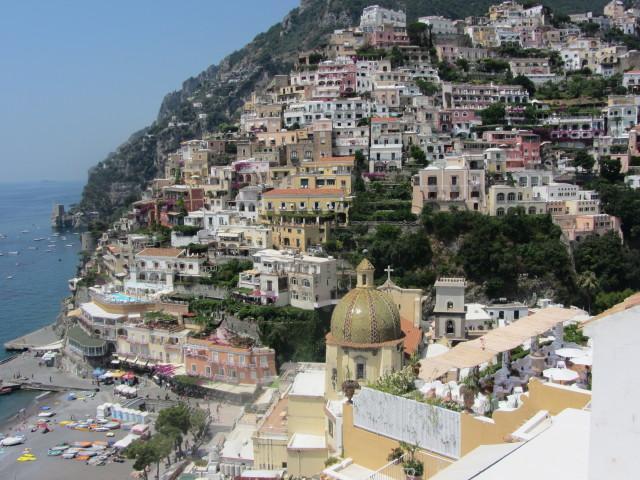
View of the city of Positano on the rugged Amalfi Coast showing the church Our Lady of the Assumption in the foreground and homes built vertically on a cliff in the background.
-
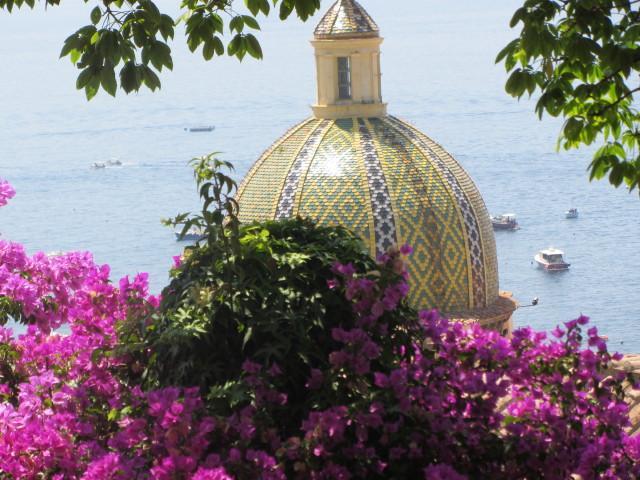
The ceramic dome of the church of Our Lady of the Assumption in Positano on the Amalfi Coast.
-
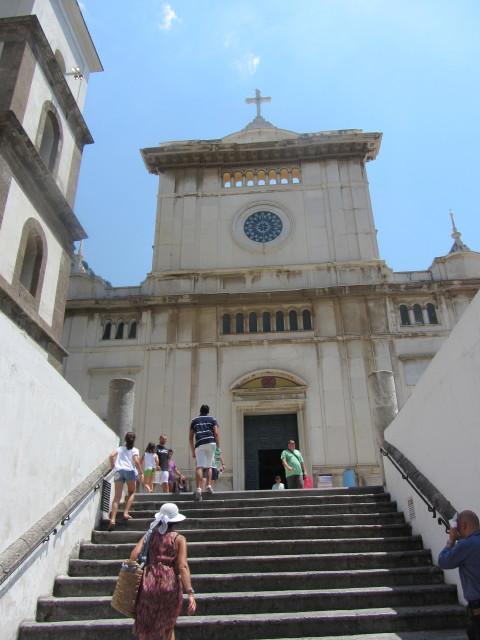
Entrance to the church of Our Lady of the Assumption in Positano. The church was constructed as a Benedictine Monastery in the 10th century and remodeled between 1777 and 1783.
-
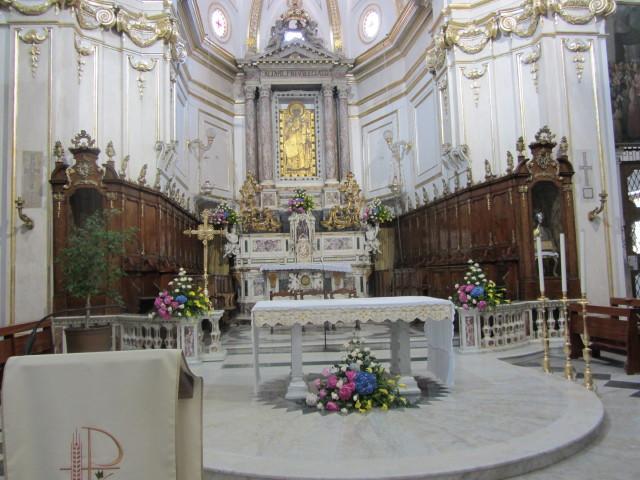
Altar inside the church Our Lady of the Assumption in Positano on the Amalfi Coast. Above the altar is a 13th century Byzantine Black Madonna and Child.
-
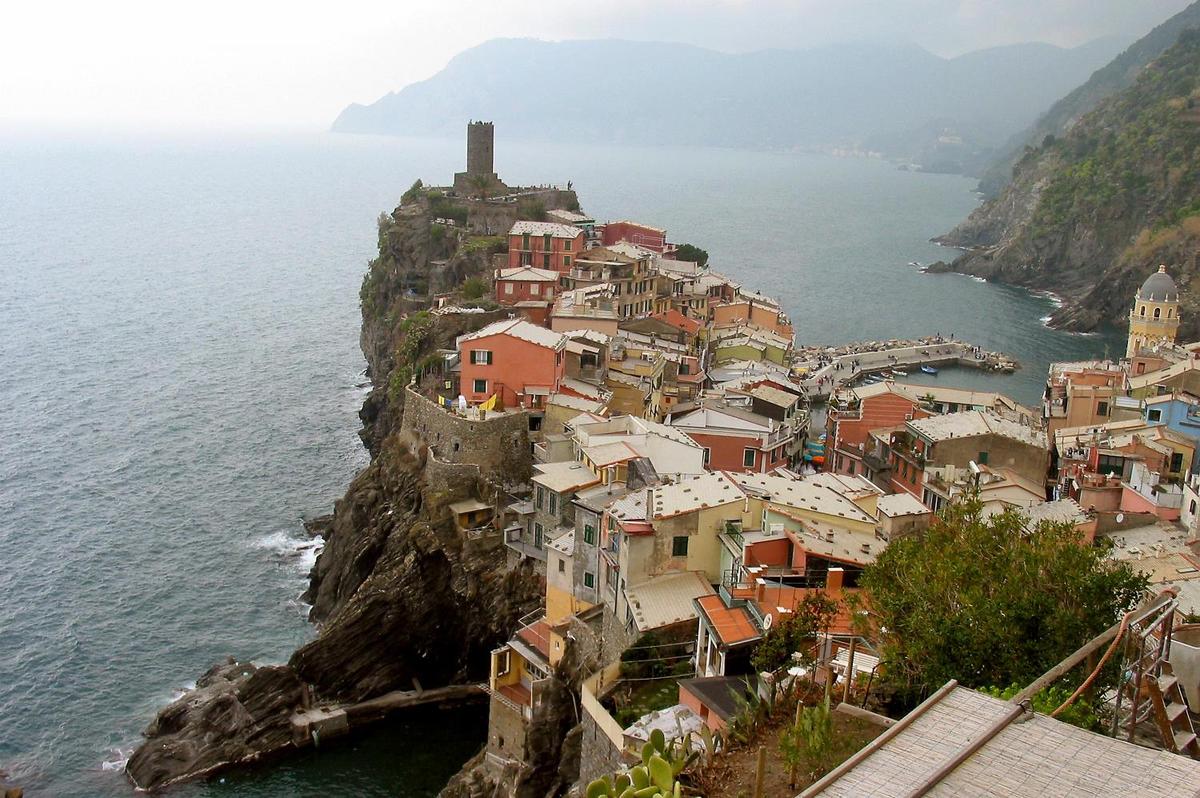
The town of Vernazza on the Italian Riviera is part of the Cinque Terre National Park (a World Heritage Site) established in 1999; which consists of five picturesque villages reached only by hiking trail, train, or ferry.
-
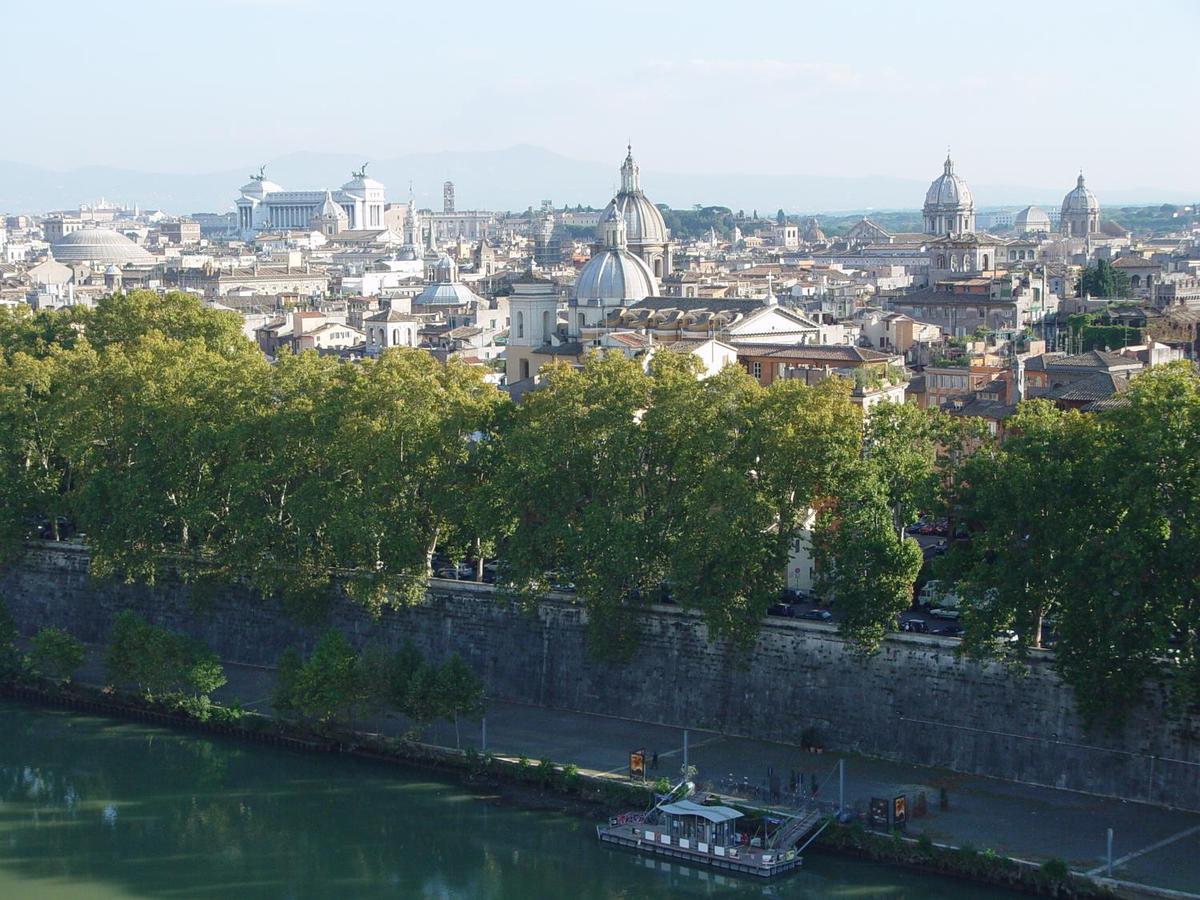
The ancient and historic city of Rome, showing the dome of the Pantheon on the left, the Monument of Victor Emanuel II in the left background, and various church domes.
-
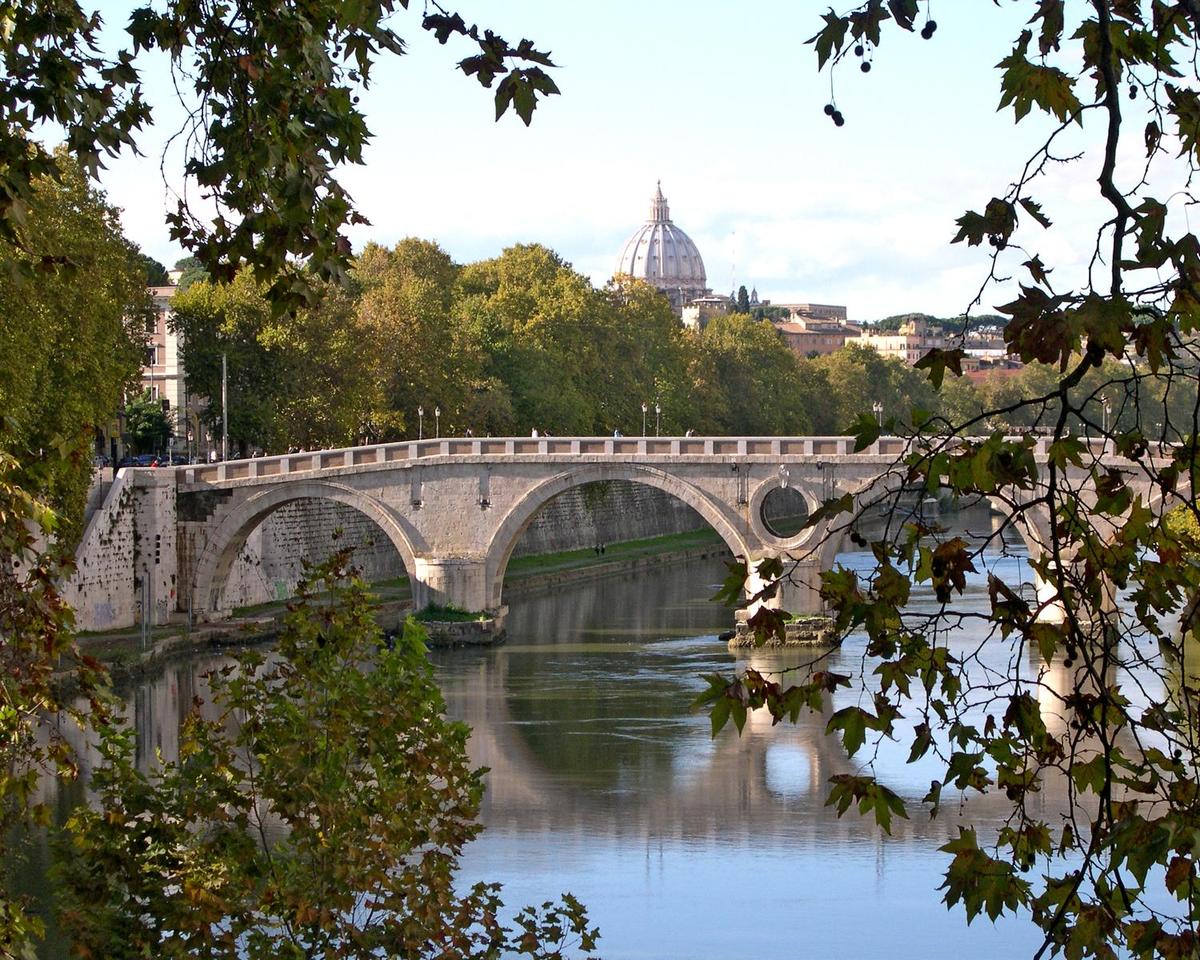
The Garibaldi Bridge over the Tiber River in Rome. The dome of St. Peter's Basilica appears in the background.
-
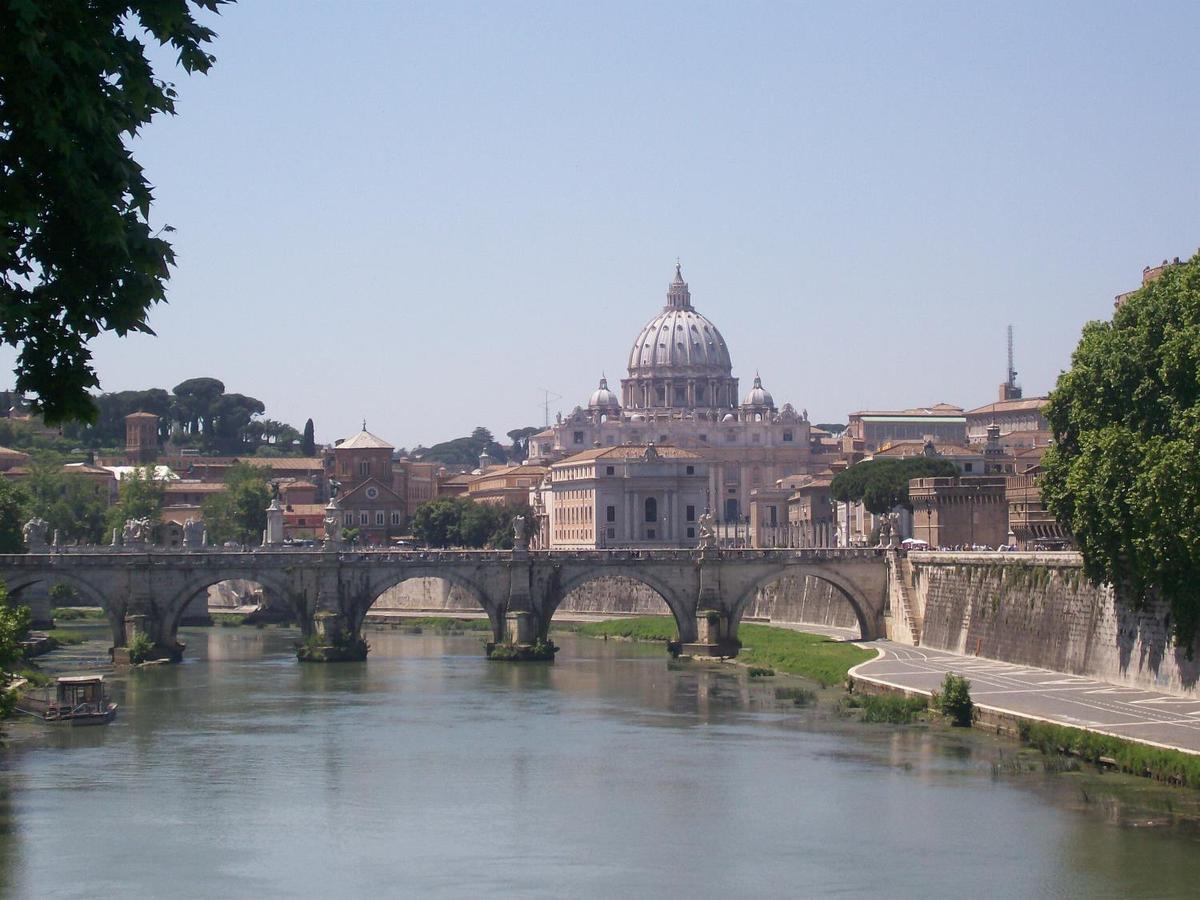
The Vittorio Emanuele Bridge over the Tiber River in Rome with Vatican City in the background. The bridge was completed in 1911.
-
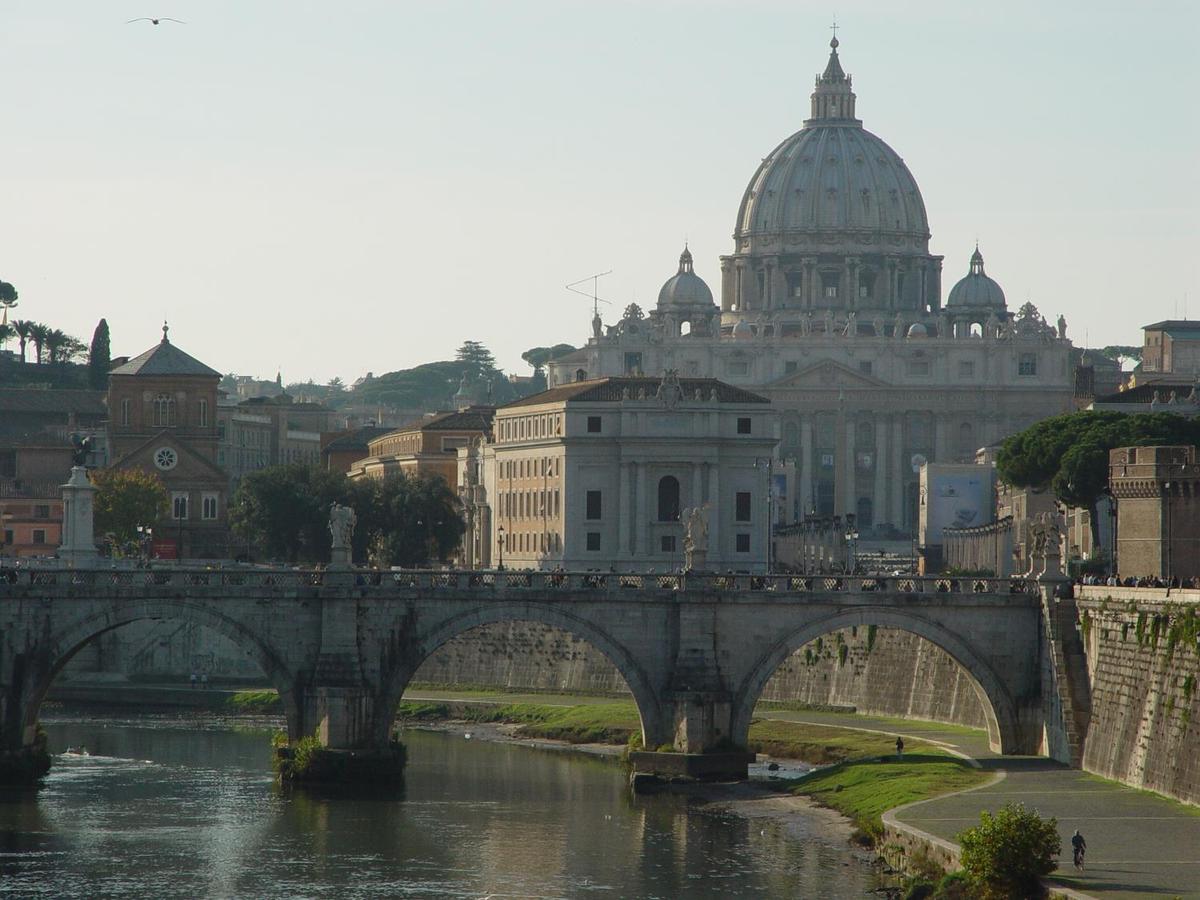
The Vittorio Emanuele Bridge over the Tiber River in Rome with Vatican City (and St. Peter's Basilica) in the background.
-
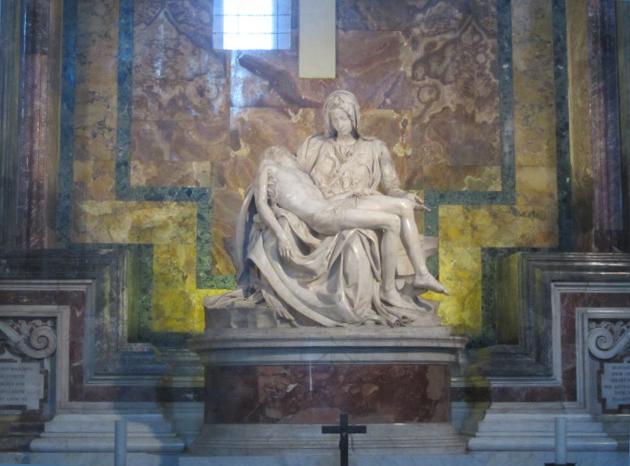
Pieta by Michelangelo in Saint Peter's Basilica in Rome. The sculpture was created from 1498 to 1499 of Carrara marble when the sculptor was only 25 years old.
-
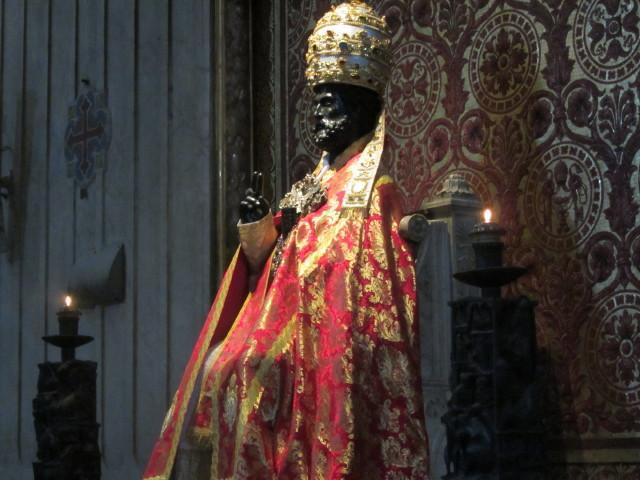
Figure of St. Peter in vestments on the occasion of his feast day on 29 June in Saint Peter's Basilica in Rome.
-
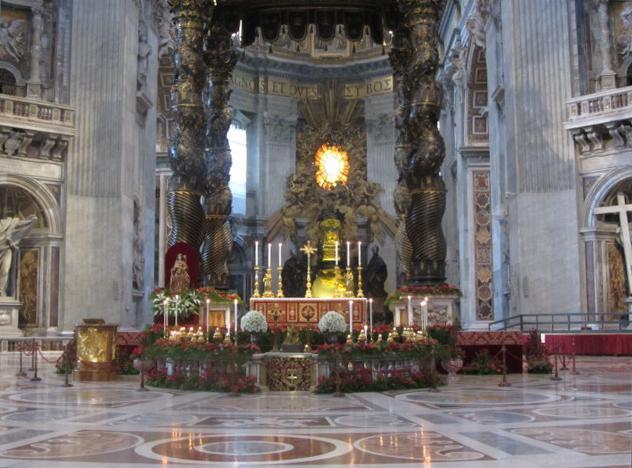
The main altar in Saint Peter's Basilica in Rome is covered by a 30m- (98 ft-) tall bronze baldacchino (canopy) designed by Gian Lorenzo Bernini.
-
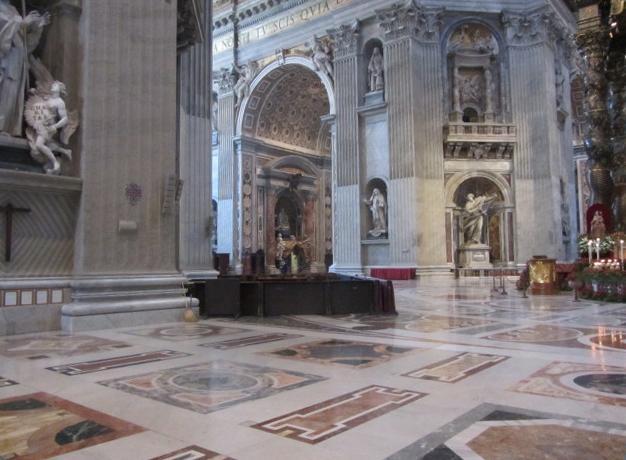
View to the right of the main altar in Saint Peter's Basilica in Rome.
-
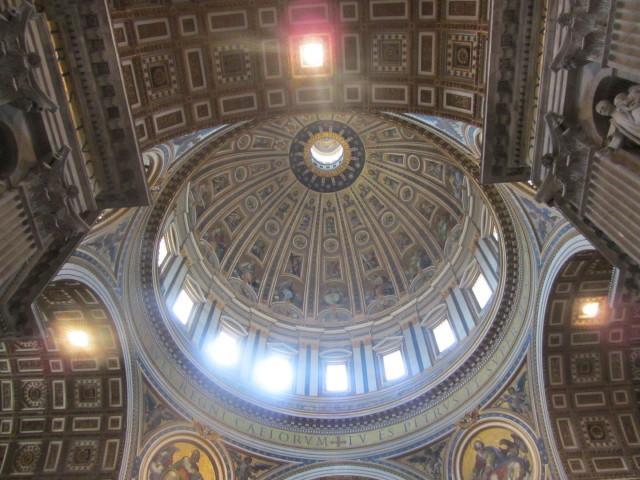
The dome over the main altar in Saint Peter's Basilica in Rome was designed by Michelangelo in 1547; it was completed in 1590 after his death. The dome is 136.57 m (448.1 ft) high making it the tallest dome in the world.
-
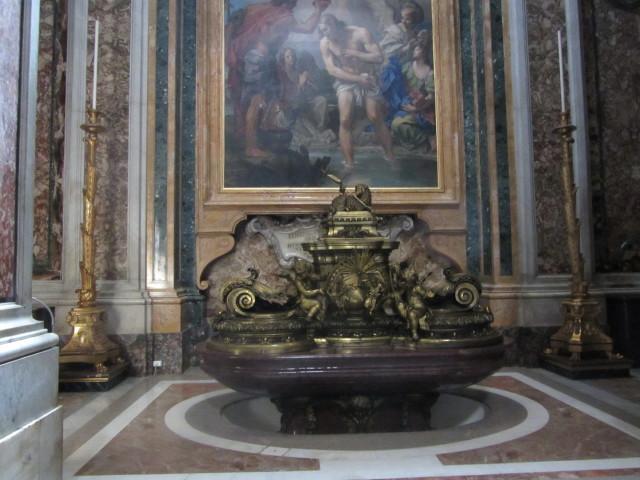
Baptismal font in St. Peter's Basilica in Rome.
-
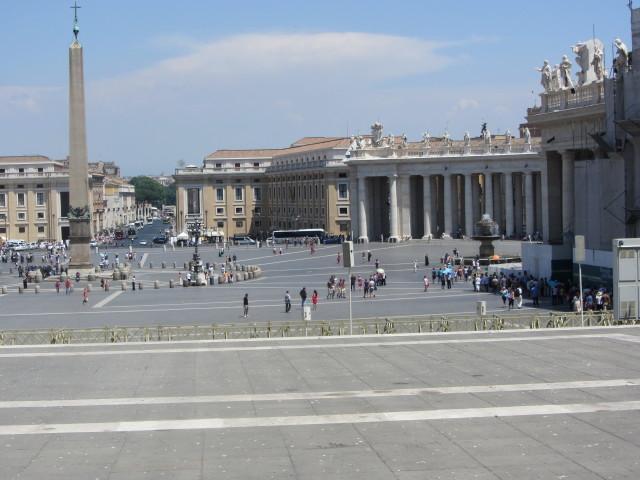
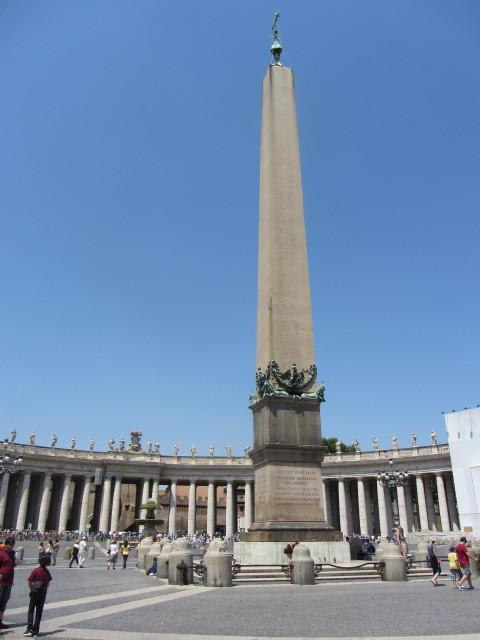
View of Saint Peter's Square in Rome showing an Egyptian obelisk, the Via della Conciliazione, and colonnades with statues on the sides of the square. The square, designed by Gian Lorenzo Bernini, was constructed between 1658 and 1667.
-
An Egyptian obelisk in Saint Peter's Square in Rome. Composed of red granite, the obelisk is 25.5 m tall (41 m to top of cross). It was transferred to Rome by the Emperor Caligula in A.D. 37, and moved to its current location at the direction of Pope Sixtus V in 1586. It is the only Egyptian obelisk in Rome never to have fallen.
-
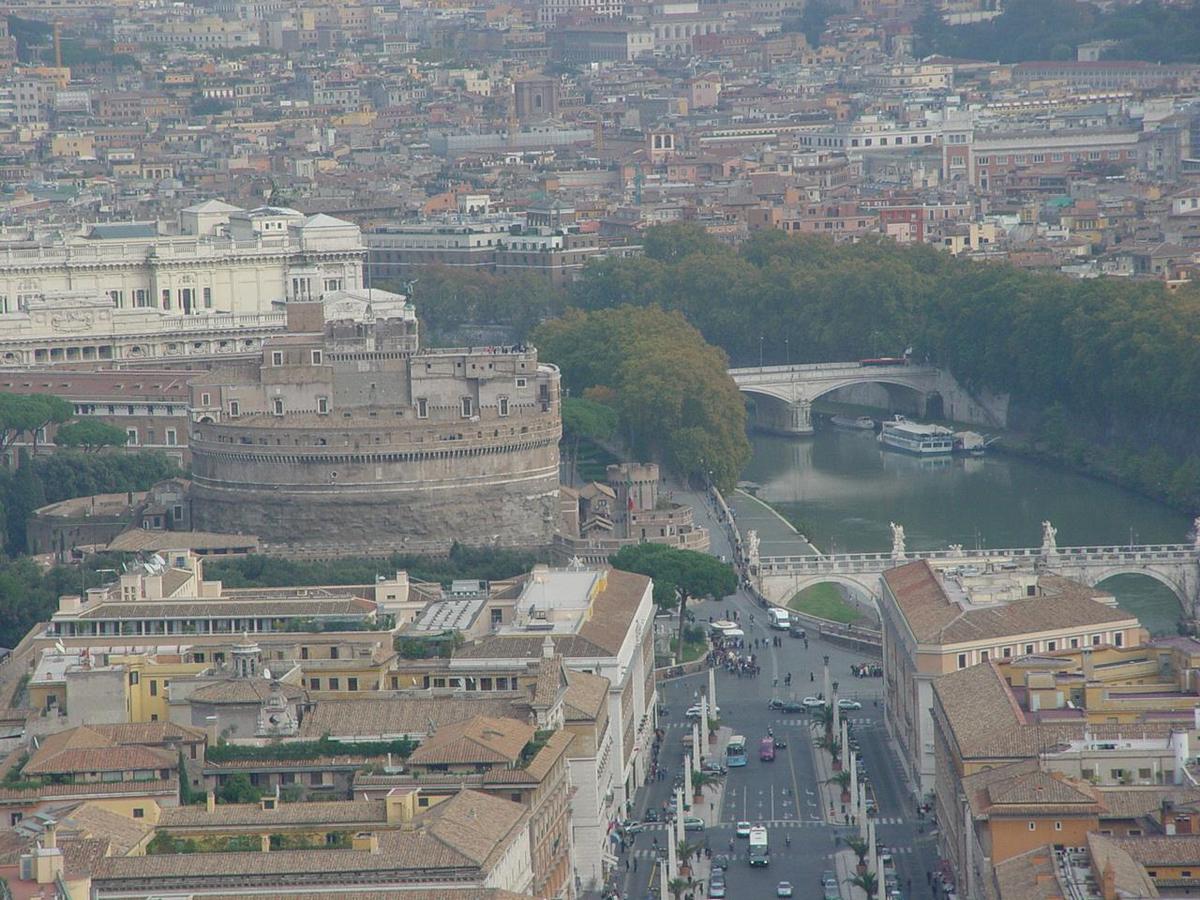
The Castel Sant'Angelo along the Tiber River in Rome is also known as the Mausoleum of Hadrian. The Roman emperor built it as a tomb for himself and his family around A.D. 135. Succeeding emperors were also entombed there. The structure was in turn a fortress, a castle, and a museum.
-
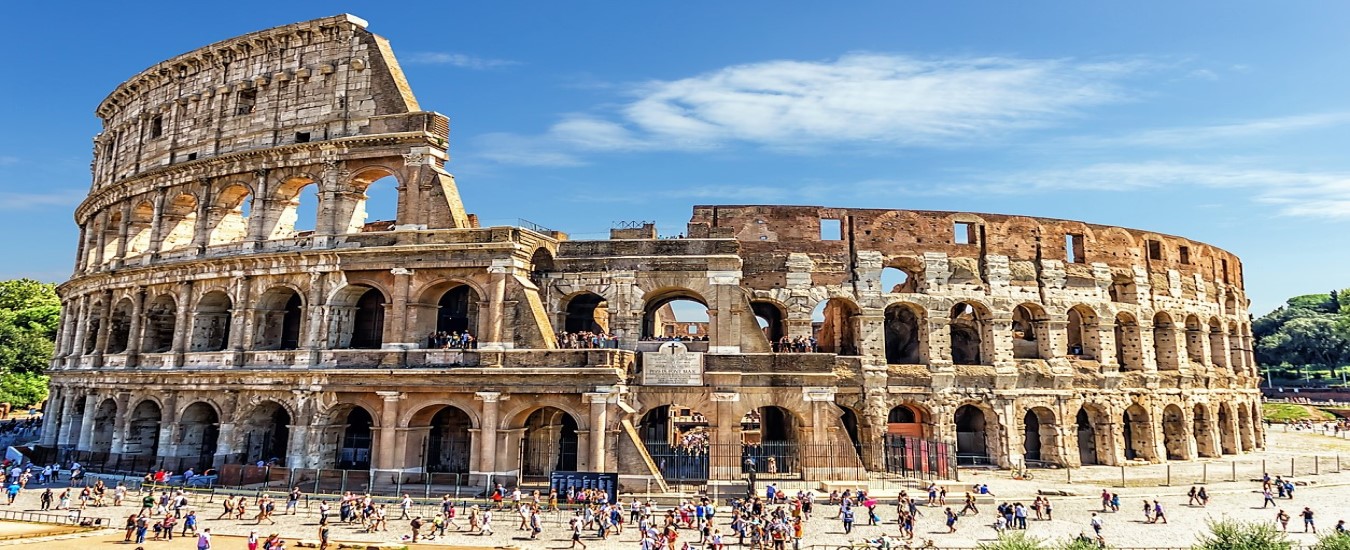
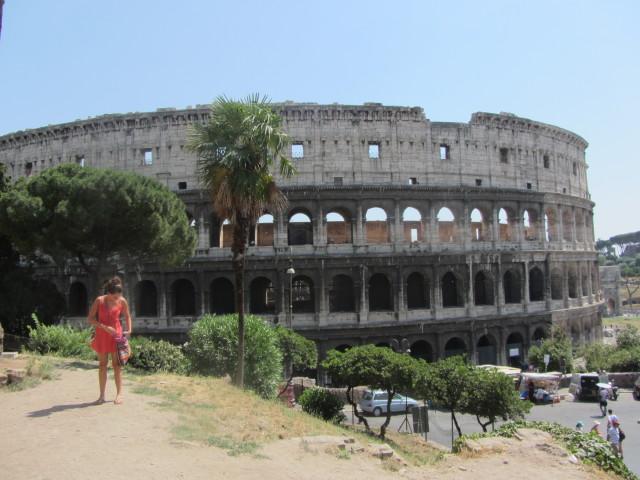
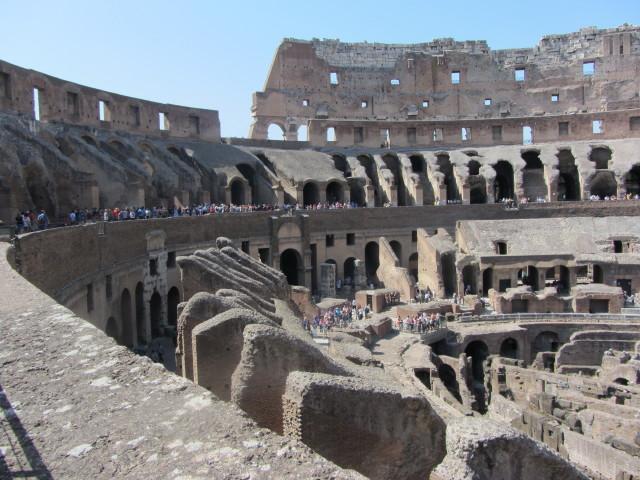
The Colosseum in Rome was first used in A.D. 80. In Roman times, it was called the Flavian Amphitheater and held 50,000 spectators. The name "Colosseum" was introduce in medieval times and referred to a giant statue of Nero that stood nearby. The outer walls have three levels of arches with columns topped by Ionic capitals at the lower level and Doric and Corinthian at the top. The 80 entrance/exit arches, known as vomitoria, allowed spectators easy access and the ability to clear the building in minutes.
-
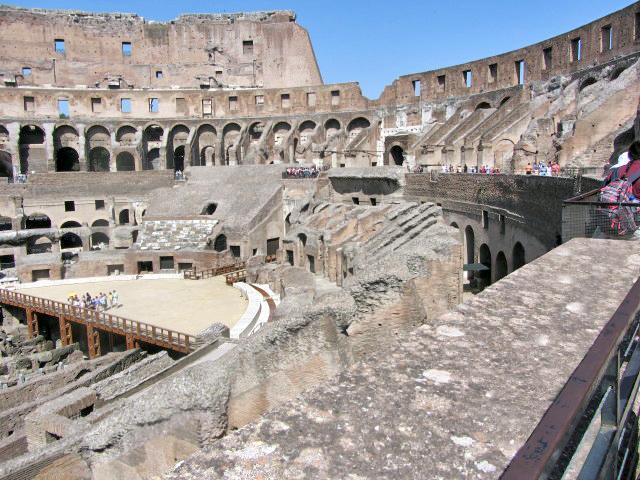
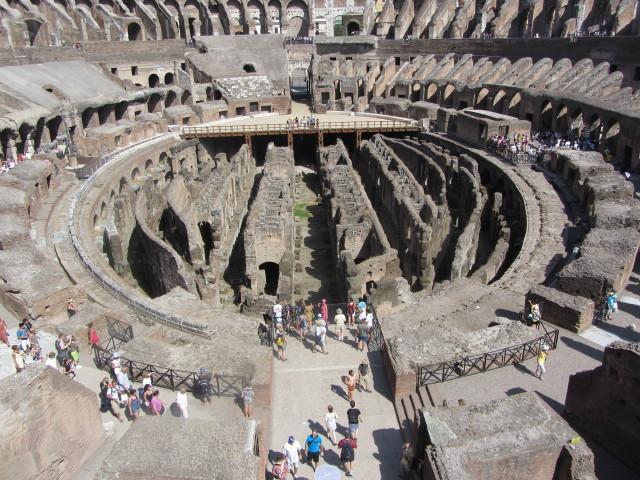
The Roman Colosseum's arena was a wooden floor covered with sand, underlain with rooms and passageways for performers, sets, and animals. Spectator seating was divided into three sections: ordinary people sat in the upper level, the better off in the middle sections, and the elite in the lower level.
-
The Colosseum in Rome had seating for 50,000 spectators. Most of the stones used for construction of the building were taken by citizens of Rome in the Middle Ages for construction of other buildings in the city. The upper level of the Colosseum had supports for 240 masts that held up a canvas awning to shield spectators from sun and rain.
-
The Colosseum in Rome showing the interior with a partial reconstruction of the wooden arena floor. The rooms and passageways under the floor were used for performers, sets, and animals. The arena could be flooded to recreate sea battles.
-
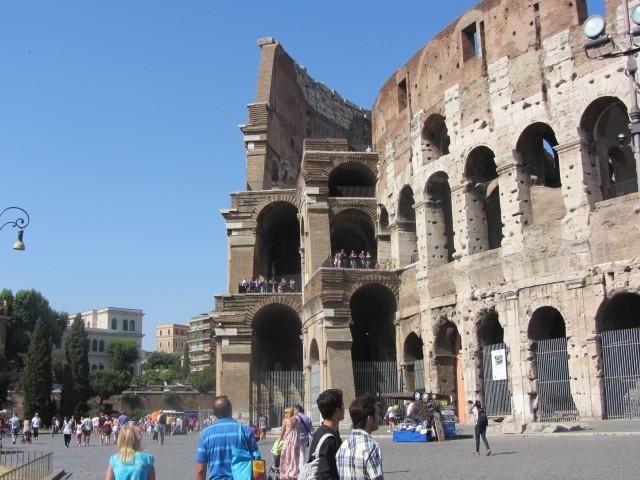
The Colosseum in Rome showing the exterior arches that once surrounded the building. Most of the arches and much of the building were dismantled in the Middle Ages by citizens of Rome who used the stone to construct other buildings.
-
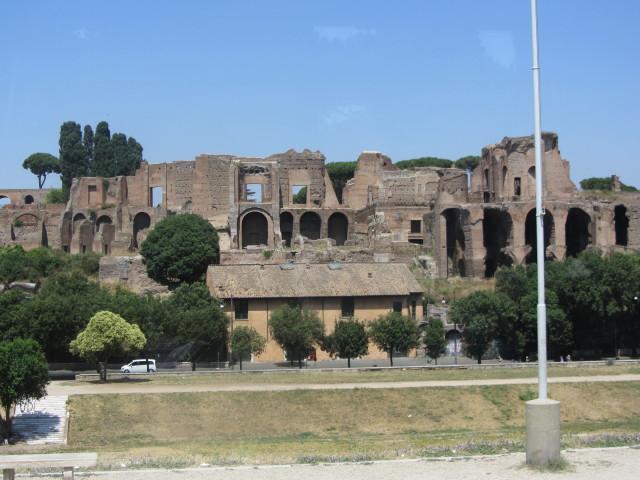
Ruins of a Roman building in Rome.
-
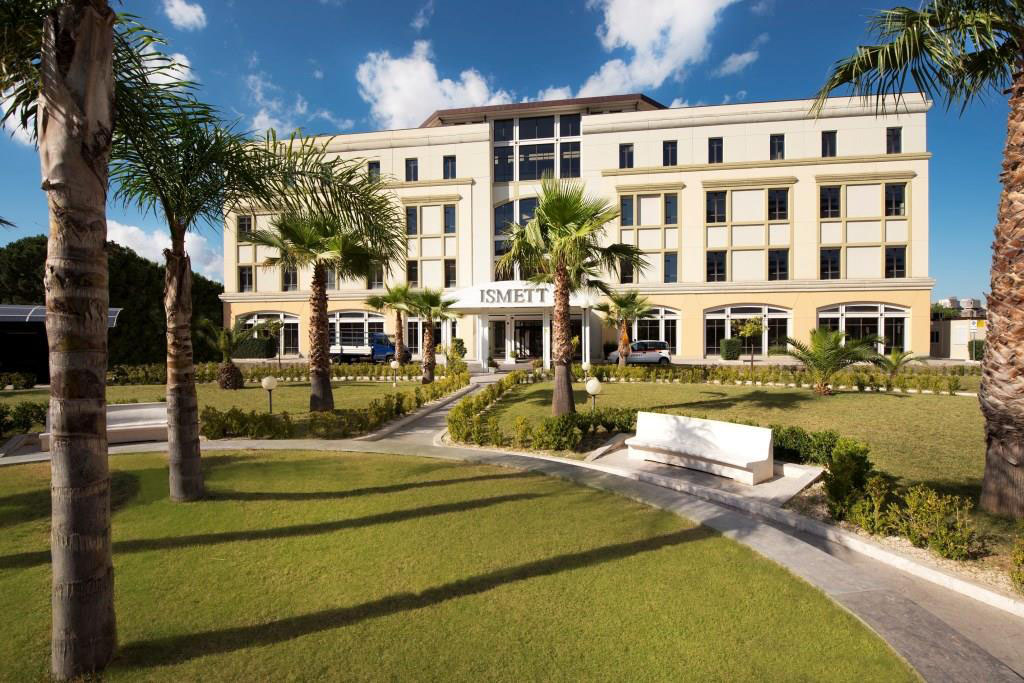
{"ops":[{"insert":"The ultra-modern"},{"attributes":{"bold":true},"insert":" organ transplant hospital (ISMETT)"},{"insert":" is located in "},{"attributes":{"bold":true},"insert":"Palermo"},{"insert":", Italy. When ISMETT opened it was the first of its kind operating transplant facility for heart, liver and kidney outside of the United States. It is a co-joint project between Italy and the United States, designed by the "},{"attributes":{"bold":true,"link":"https://www.dlaplus.com/pages/ismett"},"insert":"prestigious DLA+ architectural firm from Pittsburgh"},{"insert":". The facility has acted as a conduit to the Arab world. It continues to successfully perform surgeries today, recently completing six transplants in 24 hours. ISMETT has boosted the Sicilian economy by generating "},{"attributes":{"bold":true},"insert":"1,793 jobs"},{"insert":" and a net benefit of more than "},{"attributes":{"bold":true},"insert":"€73 million"},{"insert":". \n"}]}